




A Comparison of Budget Allocation in Maharashtra, Gujarat, and Punjab
- In Economics
- 07:56 PM, Jul 06, 2026
- Mukul Asher
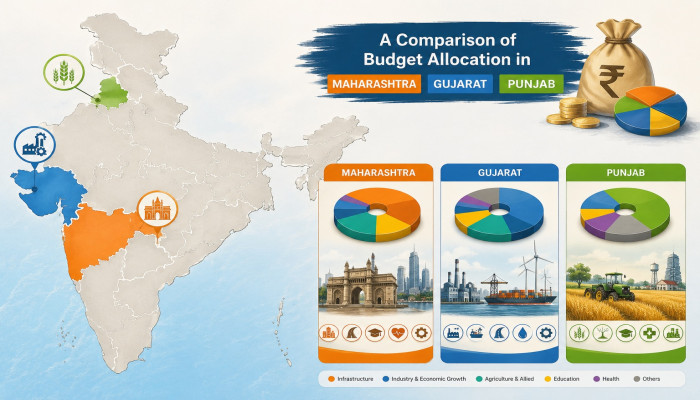
India is a "Union of States" under a strong centre. Indian states cannot secede, as India operates under a single, unified national constitution with only one citizenship. As of June 2026, India had 28 states and 8 Union Territories. India’s vision of becoming a Viksit Bharat by 2047 requires the states and the Union Territories to accelerate their contribution to India’s economic growth and social development.
According to the Reserve Bank of India (RBI), India’s Central Bank, in 2024-25, around three-fifths of the combined Central and State governments’ receipts and expenditures were intermediated through the states, underlying their importance for India’s overall development 1.
Analysing how states allocate their budgets is one of the important elements in determining whether they can meaningfully contribute to India progressing towards the goal of Viksit Bharat in 2047. This column examines the budgetary allocations for 2024-25 of three states, Maharashtra, Gujarat, and Punjab.
The original source of the data for the three states is a Report by the CAG (Comptroller and Auditor General) of India on state finances in 2024-25. I thank Mr Tushar Gupta of Substack.com for very informative figures on these three states (Figures 1, 2, and 3), which are used in this column.
Among the three, Maharashtra and Gujarat, coastal states located in the western part of India, have been leading economic contributors to the nation’s economy; while Punjab, a non-coastal state located in the Northern part of India, was strong in agricultural and small industries sectors earlier, but has been relatively lagging in recent decades.
In 2026, Maharashtra’s GSDP (Gross State Domestic Product) was INR 49.3 trillion, the largest in the country. Maharashtra’s share in India’s total GDP and in population was 13 per cent. Maharashtra state, with its current good governance and sound development orientation, is likely to be the first state in India to record a GSDP of USD 1 trillion (currently about USD 0.53 trillion). It is encouraging to observe that several states, such as Gujarat, Uttar Pradesh, Karnataka, and Tamil Nadu, are competing to reach USD 1 trillion GSDP goal.
Gujarat’s GSDP in 2026 was INR 28 trillion, about 7 per cent of India’s GDP, but its share of India’s population was around 5 per cent. Punjab’s GSDP in 2026 was INR 8 trillion, accounting for 2 per cent of India’s GDP, while its share in total population was around 2.3 per cent 2.
The three states have very divergent levels of GSDP. It follows that their budget expenditure levels or scale will also differ greatly. Thus, in the 2024-25 financial year, the total budgetary expenditure (outlay) for Maharashtra was INR 6.0 trillion; for Gujarat it was INR 3.3 trillion; and for Punjab it was INR 2.0 trillion.
Niti Aayog, in its report for 2023-24 on the fiscal health index, ranked Gujarat and Maharashtra fourth and fifth, respectively, but ranked Punjab last among the 18 states surveyed. Punjab also ranked last in quality of expenditure and in fiscal prudence 3.

Figure 1: State Budget Allocation in Maharashtra, 2024-25

State Budget Allocation in Gujarat, 2024-25

State Budget Allocation in Punjab, 2024-25
The following observations may be made from the state budget expenditure allocation in the three states (Figures 1 to 3)
- The single largest expenditure category in the three states is recurrent grants to local bodies, universities, and aided institutions, plus general expenditure, plus salaries.
The share of this category was 38.4 per cent in Maharashtra, 29.4 per cent in Gujarat, and 55.5 per cent in Punjab, which is unusually high. The expenditure in this category is not directed toward increasing the state’s future productive capacity. Therefore, the higher the share of this category, the less is available for meeting future needs of the state.
The difference in allocation in the sub-category, salaries, is also striking. Punjab’s salary allocation is 3.5 times that of Gujarat and 2.5 times that of Punjab. Similarly, Punjab’s interest on public debt allocation is 2.1 times that of Maharashtra and 1.8 times that of Gujarat. Despite all three states joining India’s national pension system arrangements introduced in 2004, Punjab’s pension expenditure allocation is 2.1 times that of Maharashtra and 1.5 times that of Gujarat.
- The starkest difference in budget allocation is for capital asset-creating expenditure. Gujarat’s allocation at 20.2 per cent is the highest, followed by Maharashtra at 12.4 per cent, and just 5.7 per cent in Punjab.
- Punjab spends 2.8 times more on subsidies than on capital expenditure, not a sustainable pattern. This one category contributes significantly to the relative decline of Punjab among the states. Allocation for subsidies in Maharashtra and Gujarat is under 10 per cent of the total expenditure, as compared to 13.5 per cent in Punjab.
In conclusion, analysing state government allocation of budget expenditure can provide insights into the contributions each state could provide towards the goal of Viksit Bharat. Among the three states, budget allocations by Maharashtra and Gujarat are consistent with continuing their significant contribution to India’s Viksit Bharat goals, though there is no room for complacency, as managing the political economy in fiscal management is a continuing challenge. The budget allocation analysis for Punjab strongly suggests that without reorientation of its fiscal (and overall) governance philosophy and much better management of the political economy, Punjab will continue to be a very weak contributor to India’s goal of Viksit Bharat.
References
- https://www.rbi.org.in/scripts/PublicationsView.aspx?id=23273 (Accessed on 29 June 2026)
- https://www.nobroker.in/blog/largest-states-in-india/ (Accessed on 5 July 2026)
- https://niti.gov.in/sites/default/files/2026-03/Fiscal-Health-Index-2026.pdf (Accessed on 4 July 2026)
Disclaimer: The opinions expressed within this article are the personal opinions of the author. MyIndMakers is not responsible for the accuracy, completeness, suitability, or validity of any information on this article. All information is provided on an as-is basis. The information, facts or opinions appearing in the article do not reflect the views of MyindMakers and it does not assume any responsibility or liability for the same.


 Loading...please wait
Comments