




Seven Hindu Families Targeted in Coordinated Assault by JeI-led coalition in Noakhali
- In Current Affairs
- 08:32 PM, Feb 20, 2026
- Vladimir Adityanaath
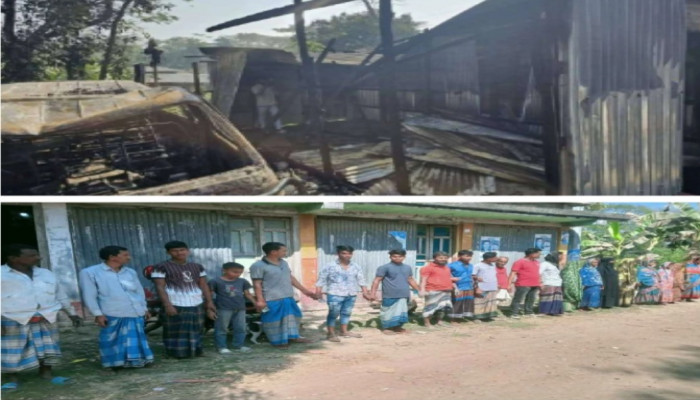
Over fifty men and women stood shoulder to shoulder in a silent human chain beneath a pale afternoon sky in Sonadia Union under Hatiya Upazila of Noakhali District. Some held handwritten placards while others stood empty-handed. All of them stood with the same demands of protection, justice and recognition.
They were residents of Hatiya upazila in Noakhali district, including at least seven Hindu families who say that within 72 hours of Bangladesh’s 13th National Parliamentary Election, their homes were attacked, looted, vandalised and set on fire in multiple instances.
From Voting to Violence
According to protesters and affected families, armed cadres associated with the Jamaat-e-Islami-led coalition, acting alongside locally organised criminal networks, initiated coordinated assaults across Sonadia, Burirchar, and Char Ishwar unions within hours of the election results being declared.
Survivors have named Mahiuddin, Hannan “Dubai,” Osman, and Zahirul Islam as principal organisers, alleging that the attacks were executed with the support and participation of several Jamaat-affiliated extremists, including Naim, Kausar, Jewel, Shakib, Hassan, Nishan, and Jiton.
Residents describe a pattern that began with political tension on polling day and escalated rapidly once results were announced. Victory processions, they say, morphed into intimidation drives. Homes were entered forcibly. Doors were smashed. Families were beaten. At least 10 houses were vandalised and looted in BanglaBazaar and Riyaz Market of Sonadia Union by armed N.C.P. cadres (a coalition partner of Jamaat-e-Islami) after the election results were announced.
On 13 February, Deepak Chandra Das and his son were beaten in a marketplace after being accused of voting for the “ধানের শীষ” (Sheaf of Paddy), the electoral symbol of the Bangladesh Nationalist Party (BNP). That same day, Kaakan Chandra Das was struck with a hammer en route to the market and the money he carried in his pocket was robbed.
Across multiple households, victims report:
a) Forced entry by organised groups.
b) Cash and gold ornaments taken.
c) Livestock attacked, resulting in the miscarriage of a goat and injuries to several cows.
d) Direct warnings to leave the area.
For rural minority families whose economic survival depends on small property and cattle, such attacks are not incidental but targeted economic destabilisation.
Homes Under Siege
Mridul Chandra Das’s residence in Ward Number 6 of Burirchar Union was surrounded by armed men who accused him of harbouring supporters of the B.N.P. party. Walls were hacked with machetes; doors were kicked down while his three daughters remained inside. The family stayed put, fearing that flight would expose the women to greater danger. According to the family, security forces did not respond promptly even after receiving direct complaints about the ongoing assaults.
Local physician Khanesh Das reports that he was threatened with a weapon during the unrest and now lives in fear, reluctant to step beyond his doorstep.
Fire as Collective Punishment
In Char Ishwar Union’s Mula Market, seven houses belonging to H. K. Sardar were burned to ashes overnight. A vehicle and two CNG auto-rickshaws were also torched. He reports that cadres associated with the N.C.P. had threatened him the previous day for refusing to vote in favour of the Jamaat-e-Islami-led coalition.
Arson in post-election settings is rarely random. It functions as collective punishment and is a warning that political transition can carry communal consequences.
The State’s Response
The Officer-in-Charge of Hatiya Police Station has stated that written complaints would be investigated, noting that some matters were reportedly being addressed through “social compromise.”
Such language, while common in rural dispute resolution, sits uneasily beside allegations of coordinated assault and arson. Criminal violence is not a matter for compromise but a matter for prosecution.
As of this writing, victims have demanded a transparent investigation, identification of perpetrators through available footage, and security guarantees.
The Shadow of 2001
For many in Bangladesh’s Hindu minority, these events do not exist in isolation.
Following the 2001 parliamentary election, supporters of the Bangladesh Nationalist Party and Bangladesh Jamaat-e-Islami were widely accused by domestic and international human rights organisations of carrying out a pogrom against Hindus across multiple districts. Reports documented assaults, sexual violence, looting and forced displacement for months after that election.
The scale and severity of 2001 left a lasting scar in the minds of Bangladeshi Hindus.
The fear of people like Khanesh Das is not abstract; it is historical.
A Democratic Fault Line
Democracy is not merely the mechanics of voting. It is the assurance that participation does not invite reprisal.
If citizens can be attacked for suspected ballots, electoral participation becomes a calculated risk. If arson and assault are met with informal compromise rather than swift prosecution, impunity hardens.
Bangladesh’s democratic credibility does not hinge solely on turnout figures or victory margins. It rests on whether minorities can vote and continue living the next day securely.
The human chain in Sonadia Union was small. But its symbolism was large. It represented citizens who believe in the electoral process enough to demand its protection.
Democracy is not proven by counting votes but by protecting voters.
That protection faltered in Noakhali during those 72 hours. Whether it is restored through transparent investigation and accountability will determine not only justice for seven families but confidence in the system itself.



 Loading...please wait
Comments