



$70 billion data centre push takes centre stage as Lok Sabha clears Finance Bill 2026
- In Reports
- 12:58 PM, Mar 26, 2026
- Myind Staff
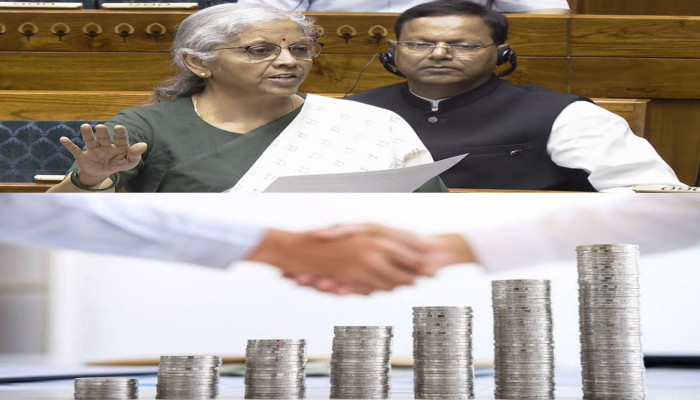
The Lok Sabha on Wednesday passed the Finance Bill, 2026, after an extensive debate, with Finance Minister Nirmala Sitharaman highlighting a major push towards data centre investments and long-term economic growth. A key announcement was that investments worth $70 billion in data centres are already underway in India, supported by tax incentives designed to promote domestic value creation and employment.
Addressing concerns raised by the Opposition, Sitharaman clarified that the tax holidays offered to foreign companies in the cloud services sector come with “structural conditionalities.” These are meant to ensure that benefits do not simply flow to large global firms without contributing to India’s economy. She said, “The 2026-27 Budget has designed its tax holidays with structural conditionalities and complementary skilling initiatives to ensure domestic value creation happens.”
The Union Budget had announced tax holidays until 2047 for foreign companies providing cloud services globally using Indian data centre infrastructure. The finance minister explained that these benefits are not unconditional. Companies must use a physical data centre infrastructure located in India. This requirement ensures that operations, maintenance, and employment remain largely within the country.
She also stated that companies serving Indian users must route their sales through Indian reseller entities. This step is expected to create a wider ecosystem of Indian businesses, including system integrators, managed service providers, and telecom partners. According to her, this framework ensures that value and employment are retained within the domestic economy.
Sitharaman further explained that the Safe Harbour Rule included in the Finance Bill ensures that Indian entities involved in such operations are not merely nominal participants. Instead, they must carry out meaningful work and earn adequate profits. The proposed 15.5% safe harbour margin for IT services ensures that Indian companies are fairly compensated for their contributions. “So, this guarantees Indian entities are adequately compensated for real work performed by local professionals,” she said.
The finance minister emphasised that India’s cloud capacity is expected to grow four to five times by 2030. This rapid expansion will create significant demand for construction, cooling systems, power management, cybersecurity, and network operations. She noted that these developments are likely to generate lakhs of direct and indirect jobs across the country.
During her speech, Sitharaman described nation-building as a gradual and continuous process. She said each finance bill contributes towards the broader vision of achieving “Vikasit Bharat” by 2047. She added that India is pursuing reforms not out of compulsion, but with “clarity, commitment and confidence.” According to her, “India is riding on the reform express under the leadership of Hon’ble Prime Minister Shri Narendra Modi, and this Finance Bill of 2026-27 rests on five clear principles.”
She outlined these principles as trust-based tax administration, improving ease of living for citizens, empowering MSMEs, farmers and cooperatives, strengthening India’s position as a global business hub, and facilitating seamless trade through customs reforms.
Responding to criticism that the Finance Bill does not address middle-class concerns, Sitharaman rejected the claim and cited several measures. She pointed out that the government reduced the Tax Collected at Source rates under the Liberalised Remittance Scheme. The rate for education-related remittances has been cut from 5% to 2%, while for overseas tour packages it has been reduced from 20% to 2%. Additionally, customs duties on 17 critical life-saving medicines have been removed.
On the issue of compliance, particularly for MSMEs, she said the government’s approach is to support and facilitate first, and enforce later if necessary. Increased use of technology has made compliance easier for both individuals and small businesses, she added.
Sitharaman also addressed concerns about cesses and surcharges being kept outside the divisible pool. She stated that this practice is constitutionally valid and similar to how states are allowed to levy certain taxes. “We are using a provision that is legitimately provided. We are allowed to do it, and we are doing a legitimate thing,” she said.
She explained that funds collected through cesses are used for development projects across states, including hospitals, schools, and roads. She added that in many cases, the full amount collected is transferred to states. Between 2019-20 and 2024-25, the Centre collected ₹15.14 lakh crore through cesses but distributed ₹15.97 lakh crore to states under various schemes.
The finance minister also responded strongly to criticism from Trinamool Congress leader Sougata Ray regarding distributive justice. Referring to welfare schemes, she questioned the implementation of such programs in West Bengal. She highlighted the Pradhan Mantri Shramik Protsahan Yojana, stating that over 7 lakh tea garden workers in Assam have benefited from it.
Taking a direct dig at the West Bengal government, she said in Bangla: “Chai Chaa Bagaaner Shromiker Sathey Onnay Korechey (There has been injustice with 3.79 lakh tea garden workers).” She further alleged that central schemes like PM KISAN and Ayushman Bharat were blocked in the state, affecting farmers and families. “Their distributive justice has one filter - Are they TMC’s cardholders or party members? Then they’ll give everything to them. Chai Bagaan workers aren’t TMC members, so they won’t get it. Are they talking about distributive justice? I’m ashamed to hear it,” Sitharaman said.
During the debate, Congress leader Manish Tewari raised concerns about changing global conditions, particularly the impact of the ongoing war in West Asia. He argued that the assumptions on which the budget was based may no longer hold true and asked how the conflict would affect India’s economy, especially fuel and food prices.
Another Congress leader, Deepender Singh Hooda, highlighted concerns about the falling value of the rupee and rising fuel and fertiliser costs. He stated that the rupee has weakened significantly and pointed out that it recently hit a record low of 93.94 against the US dollar. He also compared the situation with the UPA period, noting that the rupee was stronger despite high global crude oil prices.
Despite these concerns, the Finance Bill, 2026 was passed after the discussion, marking another step in the government’s broader economic roadmap.



 Loading...please wait
Comments