



2011 Census: A Snapshot
- In Society
- 04:00 PM, Sep 09, 2015
- Nilesh Singh
Since the historic win of NDA last year, one of the things that many were expecting the government to disclose was the 2011 census report. There have been a lot of speculations on the reason behind the UPA-2 government's decision to hold on to the release of the report. The then upcoming 'loksabha' elections of 2014 were the biggest reason of all, if not the only reason.
Now that the government has finally made the report public (notwithstanding the leaked reports and the imaginary figures quoted by many) the question that bewilders me is - why was there so much of fuss over a report which appears pretty much on the lines of the trend that we have seen in the previous census reports? The elephant in the room that few were searching for is missing altogether, although there are few bulls around which we will come to later!
There are already a number of articles that take a stab at the latest census reports and many of them have done a great job in depicting the data in the form of interactive charts. This is the reason I would not be dwelling much into the granularity of data but would like to present an overall picture of what I understood and could infer from the census report.
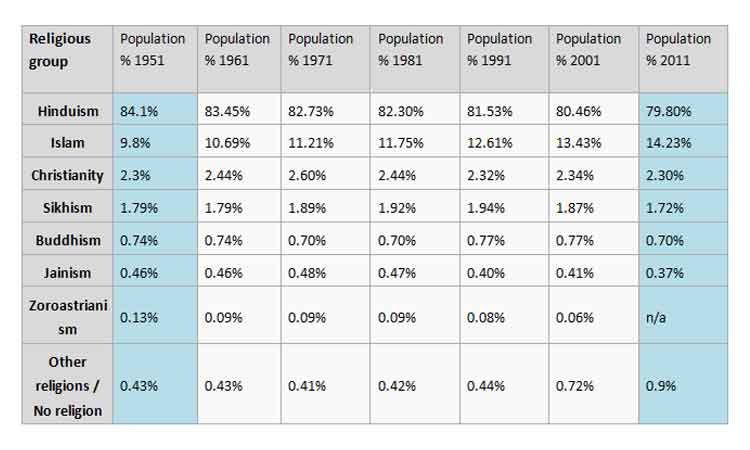
Let me start with a table (source: Wikipedia) to present you all with a single level of information on the population trends since 1951.
I have intentionally highlighted the figures from first and the latest census done since Independence. Now, as I mentioned in the beginning that the figures do not come as a much surprise to me and the reason behind it is the trends that we see in the table. Except for the Muslim population, the population percentage of other religions has either come down or has remained more or less the same since 1951. If we speak only based on the latest census report, it is just the population percentage of Muslims that has gone up, rest all are on a negative slope (discounting the much ambiguous figures of last two rows). This has been the trend in previous census reports as well and was therefore expected.
Having painted the overall picture (not enough though) let me get to the positive things that has come up in the report.
First, let us talk about the 'sex ratio'. In the latest census report, the number of women per 1000 men stands at a much improved level at 943. This number was 933 during the 2001 census. To make the news even better, the improvement in sex ratio is seen among all the major religions. Hindus though are still a long way behind other religions when it comes to the sex ratio with only Sikhs have ratio greater than 1.
But the bad news is that the number for the child sex ratio (age 0-6) which for some unknown reason has come down from 927 a decade back to 919 in the year 2011. This is both baffling and saddening. Just by looking at the state/UT wise data, the surprise comes for J&K and Lakshadweep where the 'child sex ratio' has fallen steeply. Daman & Diu along with Dadra Nagar Haveli has also seen a steep fall in the sex ratio but most of it could be attributed to the massive influx of migrants coming from other parts of India in search of livelihood. First bull down!
The second positive news to come out of the report is the literacy rate which has moved about 10 percentage point to 74% as compared to the previous census. Again the improvement in the literacy is across the board with women much behind men as has been the trend since independence. This is one section where I firmly believe that the women would catch up with men in a decade or so. Quite understandably the poor states like Bihar, UP, Jharkhand etc. have seen the most increase in the literacy rate.
The third positive news is the dip in the fertility rate, that too across the board. Muslims still have a higher fertility rate than any other religions but the rate itself in percentage term over the previous census has been declining. With a growing economy, better education and healthcare the fertility rates are bound to come down. There is no surprise when we see the states with higher fertility rates are the ones which are poor and lag behind others in terms of above mentioned parameters. Having said that we do have few anomalies, like in the case of Kerala where the literacy rate and even the sex ratio of three major religions are almost the same but the fertility rate among the Muslims is much higher than Hindus or Christians. This poses a serious question on the number of educated people who still share some orthodox thoughts related to the birth control. Although it is poverty that remains the major reason for high fertility, combined with orthodoxy (irrespective of religious beliefs) becomes a deadly weapon as we see in the case of Bihar, UP etc. That is another bull down!
Taking this bull by its horns, the humungous increase in Muslim population in Assam has been a much debated figure recently and is been attributed to the influx of people from the neighboring Bangladesh. Even though we don't have any proof to justify this inference the logic does gravitate toward this very thought otherwise this trend would be the biggest deviation from the norm when compared to the similar data from across the country!
Now let me briefly talk about another aspect of population which at first glance doesn't look connected to the census per se but is - Reservations. It baffles me that the SC/ST quotas are only given to the people who consider themselves as Hindus. This could be a major reason that the Christian population as the percentage of total population has remained exactly the same since the first census post-Independence. I have no qualms with people changing their religions due to poverty or due to the caste based discrimination, but I get a lot of anecdotes from my friends and had couple of first hand witness where people convert to Christianity but call themselves SC/ST to avail the benefits they may be eligible for. We call ourselves a democracy and therefore I believe the reservations should be for all who deserve, irrespective of their beliefs. The worst logic appears when few state governments provide quotas based on the religious belief of a sect, calling them as minorities. A snapshot of the census figures can help us find the factual minorities and looking at the state level data would further give a new dimension to the vote churning word - 'minority'. I say this in anger because I am against any kind of reservations. The caste based discrimination would end only with the demise of reservations done based on caste!
To conclude, I find a lot of positives coming out of this census report and am very sure that the 2021 census will have even better figures that would bring our country closer to the designation of being called a developed nation. With the data as huge as our census report, there are always some surprises and trends that we like to discuss, some genuine some baseless but as long as we genuinely think of our 'sava sau crore' population as a single entity and believe in 'sabka saath, sabka vikaas', sky indeed is the limit for us!
By Nilesh Singh



 Loading...please wait
Comments