




Xi Jinping, Kim Jong Un signal stronger alliance as ties enter ‘new historical starting point’
- In Reports
- 01:01 PM, Jun 09, 2026
- Myind Staff
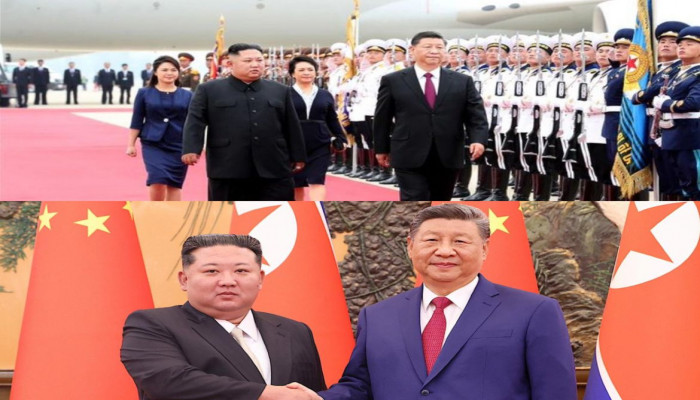
North Korean leader Kim Jong Un and Chinese President Xi Jinping agreed to strengthen cooperation in politics, the economy, and culture during a summit in Pyongyang. According to North Korea’s official KCNA news agency, the meeting marked a new chapter in relations between the two countries.
Xi’s visit is significant as it is his first trip to North Korea in seven years. North Korea remains China’s only formal treaty ally. During the summit, Xi expressed his commitment to deepening ties between the two neighbours. Both leaders agreed to increase strategic communication through more exchanges and visits by senior government officials.
Kim also reaffirmed his support for the “One China principle.” According to KCNA, he told Xi that North Korea would fully support the policy regardless of changes in the international situation. China considers Taiwan a part of its territory and maintains that both sides of the Taiwan Strait belong to one country. Taiwan, however, rejects Beijing’s sovereignty claims. China has also never ruled out the use of force to bring Taiwan under its control.
Although both sides highlighted their close relationship, analysts observed differences in how the summit was presented by the two countries. China’s official Xinhua news agency focused heavily on practical cooperation. Its report highlighted plans related to high-level exchanges, trade, agriculture, and the restoration of transport links between the two countries.
North Korea’s KCNA, however, portrayed the meeting as a partnership between equals. Analysts said the North Korean report focused more on national dignity and the long-standing special relationship between the two neighbours.
Lim Eul-chul, a professor at South Korea’s Kyungnam University, said Pyongyang emphasised regime dignity and the countries’ “special relationship,” while Beijing focused more on practical state-to-state cooperation and its vision for international order.
Hong Min, a senior research fellow at the Korea Institute for National Unification, said North Korea intentionally shaped its message to avoid appearing dependent on China. He said, “North Korea removed elements that could make it look like a subordinate, dependent or beneficiary party, and rewrote the relationship as one between equals.”
He added, “It amplified signals of solidarity, such as anti-U.S. and Taiwan-related messages, while erasing signals of dependence or subordination.”
It remains unclear whether Xi and Kim planned additional talks on Tuesday. South Korean media reported that Xi was expected to visit the Sino-Korean Friendship Tower in Pyongyang. The monument honours Chinese soldiers who died during the Korean War.
As part of the visit, Xi and Chinese First Lady Peng Liyuan attended a cultural performance featuring Chinese and North Korean songs. They were accompanied by Kim, his wife Ri Sol Ju, and several senior officials from both countries.
According to KCNA, the performance highlighted patriotism, revolutionary values, and national pride. The songs were intended to showcase “the value and closeness of DPRK-China friendship.” DPRK is the official name of North Korea, the Democratic People’s Republic of Korea.
Kim also hosted a banquet for Xi and his delegation. During the event, Xi expressed his appreciation for North Korea’s warm welcome. According to KCNA, Xi said he wanted to “share friendship” with Kim and thanked the country for its hospitality.
The banquet was held as part of celebrations marking the 65th anniversary of the friendship treaty between China and North Korea. KCNA reported that Xi described relations between the two countries as having reached a “new historical starting point.”
Earlier, Xinhua reported that Xi had pledged that China would not move away from its commitment to protect the shared interests of both countries. He stated that Beijing would continue to stand by North Korea and support common goals.
Notably, North Korean state media did not mention whether the two leaders discussed North Korea’s nuclear weapons programme or its relations with the United States. These issues have remained key concerns in regional diplomacy for years.
Some analysts believe China may want a closer political relationship with North Korea than currently exists. Sydney Seiler, a former U.S. special envoy for the six-party talks, said parts of China’s official summary suggested Xi may be frustrated that Kim has not done enough to build stronger political trust with Beijing.
Seiler also suggested that North Korea remains unwilling to follow China’s model of economic reform and opening up. According to him, Pyongyang continues to reject lessons from China’s development experience. He is currently associated with the Centre for Strategic and International Studies (CSIS).
The summit also comes against the backdrop of possible future engagement between North Korea and the United States. During his first term as U.S. President, Donald Trump met Kim Jong Un three times. Those historic meetings raised hopes of improved relations but eventually collapsed because of disagreements over North Korea’s nuclear weapons programme. The United States wanted Pyongyang to abandon its nuclear arsenal, while negotiations failed to produce a lasting agreement.
Trump has recently indicated that he would be willing to restart talks with Kim if given the opportunity.
However, experts believe China is unlikely to play a direct role in reviving negotiations between Washington and Pyongyang. Leif-Eric Easley, a professor of international studies at Ewha Womans University in Seoul, said, “While it is highly likely that the leaders of China and North Korea would confer before Kim might meet Trump again, it is doubtful that Xi will serve as a catalyst for U.S.-North Korea talks.”
China remains North Korea’s largest trading partner. Analysts believe Xi’s visit may have focused significantly on expanding trade and boosting tourism between the two countries. Strengthening economic ties is seen as an important priority for both governments as they seek to deepen cooperation.
According to South Korea’s Yonhap news agency, Xi is expected to conclude his visit and return to China on Tuesday, bringing an end to a closely watched diplomatic trip that has once again highlighted the strategic importance of the China-North Korea relationship.



 Loading...please wait
Comments