




Great Nicobar: India’s Geoeconomic Gateway to the Indo‑Pacific
- In Military & Strategic Affairs
- 11:20 AM, Jun 09, 2026
- Rohit KA & Dr A Adityanjee
Introduction
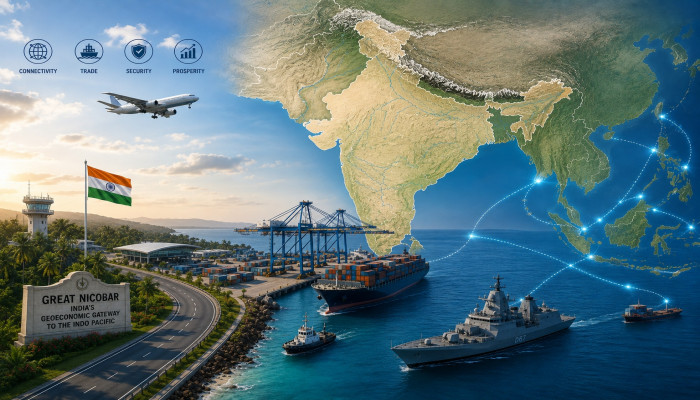
The Great Nicobar transhipment port project is more than an infrastructural plan.It is India’s attempt to anchor itself at the junction of the Indian and Pacific Oceans, capture the regional transhipment traffic and give tangible maritime content to its Look East/ Act East policy. By leveraging the island’s location near key sea lanes of communication (SLOCs) and integrating the port with an airport, power plant, and township, India hopes to reposition itself within Indo-Pacific trade and connectivity networks.
Background
To understand the Great Nicobar Project, it is first necessary to position itself within India’s broader journey in the Indo-Pacific and the evolution of its Look East/Act East policy. understand India’s larger journey in the Indo-Pacific and the evolution of its Look East/Act East policy.
In the early 1990s, after the end of the Cold War and India’s own economic reforms, New Delhi realised that its future economic growth and security would depend heavily on linkages with Southeast Asia rather than just the subcontinent. India was not welcome in the APEC due to resistance from some of the ASEAN countries like Malaysia and later due to opposition by China and the US. The Look East Policy was launched to build trade, diplomatic, and cultural ties with ASEAN countries, signalling that India wanted to “Look” beyond its near abroad or the so-called South Asia region.
Over time, this “Look East Policy” turned into an Act East policy. This more active, implementation-oriented framework focused on physical connectivity, trade integration, and security cooperation in the wider Indo-Pacific. The idea was no longer just to talk or sign agreements but more to invest in roads, ports, air links, and regional partnerships that would tie India into the global supply chain network. The Indo-Pacific itself emerged as the new strategic-economic geography of the 21st century, where the Indian and Pacific Oceans meet and where the bulk of global trade flows.
Against this backdrop, the Great Nicobar project represents one of India’s most visible attempts to translate its Act East commitments into concrete maritime infrastructure at the junction of the Indian and Pacific Oceans. There are loud and motivated criticisms and legal challenges from biased parties, including NGOs and political opposition, on environmental grounds and on grounds of disturbing the habitats of tribal populations.
Geostrategic relevance of Great Nicobar
Great Nicobar is India’s southernmost inhabited island in the Andaman and Nicobar archipelago, placed very close to the Six Degree Channel and the western approaches to the Straits of Malacca and Singapore.
These straits are among the busiest chokepoints in the world, carrying a large share of global container traffic and energy flows between the Indian Ocean and East Asia. Large ships passing between the Middle East, Europe, and South Asia on one side and China, Japan, South Korea, and Southeast Asia on the other have to transit these waters.
Great Nicobar’s location places it just off the main east-west shipping routes, allowing large vessels to call at the island without major deviation from their routes. For India, this means it now has a sovereign island-based node right at the doorway to ASEAN’s maritime core, rather than being confined to midland ports farther west.
In Indo-Pacific terms, the island becomes a forward point from which India can monitor and participate in the flow of goods, capital, and connectivity that defines the region. By developing infrastructure here, India is effectively shifting its maritime attention southward and ensuring that it is physically present at the junction of the Indian and Pacific Oceans.
The Great Nicobar Project
The Great Nicobar project is a long-term plan to develop the island as a major international container transhipment hub with supporting infrastructure. The international container transhipment port (ICTP) at Galathea Bay is the core of the plan. It is designed to handle ultra-large container ships that currently call at hubs like Singapore, Colombo, or Port Klang.
According to information from World Trade Scanner, the design leverages natural water depths of about 20 meters, reducing the need for extensive dredging and allowing very large vessels to berth directly. The port is planned to be built in phases: an initial capacity of around 4 million TEUs per year, with later phases pushing the total to about 16 million TEUs, making it a serious regional hub.
Alongside the port, the project includes a greenfield international airport to support both civilian and logistics-linked air traffic, enabling faster movement of cargo and people.
A dedicated power plant, based on gas and renewable energy, will supply reliable electricity for port operations, industries, and townships. Finally, an integrated township is planned to house port workers, logistics staff, service providers, and their families, with schools, hospitals, and commercial areas together.
These elements form a city port complex that is designed to function as a self-contained economic zone at the edge of the Indian Ocean, with the port as the engine of growth.
Geoeconomics - How Great Nicobar changes India’s trade and Logistics
The Great Nicobar project is fundamentally a geoeconomic move that seeks to reconfigure how India is positioned in global maritime trade. Today, a large share of India’s container traffic that requires transhipment is routed through foreign ports; these foreign ports include Singapore, Colombo, and Port Klang.
This means India pays for services such as port charges, fuel, and wharfage, but most of the value addition and infrastructure revenue remains abroad. The shipments themselves are often carried on global liners that pass very close to Great Nicobar anyway, yet they do not stop at an Indian port.
By building a large, deep-draft transhipment hub at Great Nicobar, India aims to bring that traffic inside its own territory so that cargo is rehandled at an Indian-controlled port rather than foreign ones. This reduces transit time and cost for Indian exporters and importers who trade with Southeast and East Asia, improves predictability in supply chains, and allows India to capture a share of regional cargo.
Third-country traffic moving between the Middle East, Africa, South Asia, and East Asia can also use Great Nicobar as a hub for transferring containers to smaller feeder ports.
The resulting hub-and-spoke model allows India to become a regional transhipment node, attracting shipping lines that want an efficient alternative or supplement to existing hubs.
Over time, the port can generate employment in logistics, warehousing, cold chains, bunkering, ship repair, maritime finance, and insurance, creating a broader maritime services ecosystem that aligns with national programs like Sagarmala and Maritime India Vision, which seek to make India not only a land-based manufacturing and consumption hub but also a serious maritime trading and logistics power in the Indo-Pacific.
Policy Linkage - How Nicobar Advances the Look East/Act East Policy
The Great Nicobar project is one of the most concrete ways in which India is now giving physical, maritime content to the Look East and Act East policies. Until recently, Act East was largely expressed through diplomacy, regional forums, road corridors, and some defense exercises. The India-Myanmar-Thailand (IMT) trilateral highway and connectivity schemes in Northeast India were important, but the sea carries far more trade volume than land routes.
By building a major port facing the ASEAN and East Asian maritime heartland, India is finally providing a sea-facing infrastructure for its Act East agenda. The great Nicobar hub directly links India’s domestic economy to the shipping networks that serve ASEAN, Vietnam, Indonesia, Thailand, Singapore, and East Asia.
This allows Indian trade with ASEAN and East Asia to move faster and at lower cost, making Indian goods more competitive, while also enabling regional partners to see India as a credible logistics and connectivity partner rather than only a diplomatic participant. Global shipping lines are more likely to consider an Indian port as a viable node in their east-west routes, which in turn deepens India’s integration into regional and global supply chains. India deliberately chose not to join the Regional Comprehensive Economic Partnership (RCEP) because of a lack of respect for ASEAN about Indian concerns. ASEAN itself has been a somewhat dysfunctional organisation that India has engaged with consistently without an optimal response.
In this sense, the port becomes a bricks-and-steel manifestation of the Act East Policy; instead of only attending meetings or signing MoUs, India is investing in hard infrastructure at the threshold of the Indo-Pacific's core maritime base. The project signals that India is serious about being an active, forward-present stakeholder in the region’s maritime economy, not just a passive user of external ports.
Strategic Implications
Taken together, the Great Nicobar Project marks a significant shift in how India positions itself geoeconomically and geo-strategically in the Indo-Pacific. Geoeconomically, it aims to capture transhipment traffic, stimulate port-led industrial growth, and embed India more deeply into regional and global supply chains.
This reduces dependence on foreign hubs and strengthens India’s autonomy in logistics and trade. The hub can serve not only India’s own trade but also regional and inter-regional cargo, positioning India as a central actor in the network of east-west shipping lanes.
Geo-strategically, the project places Indian infrastructure on the threshold of ASEAN’s maritime core, overlooking some of the World’s busiest sea lanes. This gives India greater leverage in discussions about connectivity, security, rules of the road, and information sharing in the Indo-Pacific. If we do not develop the Andaman & Nicobar infrastructure, dangers are that India will be run over by other powers, as happened in the South China Sea. Victor Gao, a prominent Chinese think-tank, has floated the idea that China could take over the Andaman & Nicobar Islands by making an extravagant claim. Similarly, during the 1965 India-Pakistan war, the then Indonesian the President Sukarno while supporting Pakistan, had toyed with the idea of occupying the Andaman & Nicobar Islands
The project avoids framing the hub as a direct military or security tool. The island can function as a forward node from which India supports regional trade and participates in shaping the cooperative maritime order.
By explicitly linking this forward infrastructure into the Act East policy, the project ties together location, trade, connectivity, and foreign policy intent into a coherent narrative.
India is no longer content to be a passive user of the Indo-Pacific's maritime commons but is investing in forward infrastructure that positions it as a central actor in the region’s evolving trade and strategic order. If implemented as envisaged, Great Nicobar could serve as both a geoeconomic gateway and a geostrategic anchor for India, although the pace of execution and regional responses will ultimately determine its impact. We have advocated for India to float an Indo-Pacific Cooperation Organisation for India’s economic integration with East Asia and Pacific Island countries.
Conclusions
India’s geo-strategic, maritime and geo-economic interests lie in trade and connectivity with East Asia and Pacific Island countries. The Great Nicobar transhipment port project is just one element of the economic infrastructure that India is building to safeguard its future. No amount of negative handwringing on any grounds should detract India from implementing the project at a fast pace.
References
- www.hindustantimes.com/india-news/great-nicobar-island-container-transhipment-port-notified-as-major-port-govt-101754392/
- www.maritimegateway.com/government-declares-great-nicobar-island-container-transhipment-port-as-major-port/
- www.drishtiias.com/daily-updates/daily-news-analysis/international-container-transhipment-port-in-great-nicobar-island
- www.pmfias.com/great-nicobar-project/
- https://worldtradescanner.com/International%20Container%20Transhipment%20Port%20(ICTP).htm#:~:text=The%20development%20of%20this%20Mega,the%20proximity%20including%20Indian%20Ports.
- India, APEC and the US https://myind.net/Home/viewArticle/india-apec-and-us
- Whither ASEAN: What Is in A Name? https://www.boloji.com/articles/52707/whither-asean-what-is-in-a-name
- From the Asian Century to a Peaceful and Prosperous Indo-Pacific Cooperation Organisation (IPCO) https://myind.net/Home/viewArticle/from-the-asian-century-to-a-peaceful-and-prosperous-indo-pacific-cooperation-organisation-ipco
- Why Do We Need an Indo-Pacific Cooperation Organisation (IPCO)? https://www.boloji.com/articles/52618/why-do-we-need-an-indo-pacific-cooperation-organization-ipco
Disclaimer: The opinions expressed within this article are the personal opinions of the author. MyIndMakers is not responsible for the accuracy, completeness, suitability, or validity of any information on this article. All information is provided on an as-is basis. The information, facts or opinions appearing in the article do not reflect the views of MyindMakers and it does not assume any responsibility or liability for the same.



 Loading...please wait
Comments