




Government approves ₹13,000 crore for dual-use airfield at Great Nicobar Islands
- In Reports
- 01:42 PM, Jun 09, 2026
- Myind Staff
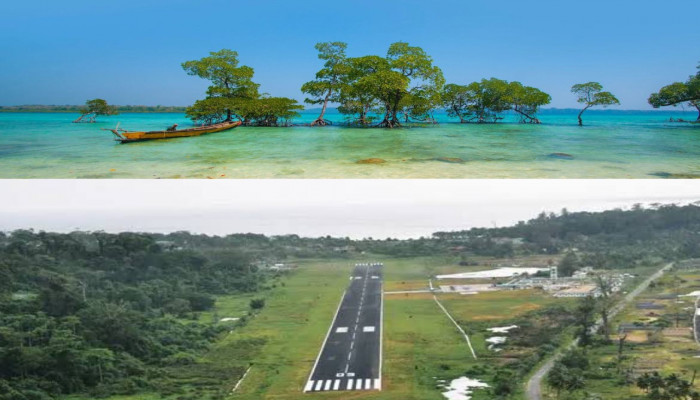
The Central Government has approved the construction of a new ₹13,000-crore greenfield civil-military airport in Great Nicobar, choosing this option over the expansion of the existing naval airfield at INS Baaz. The decision comes at a time when the ₹81,000-crore Great Nicobar Island Development Project is at the centre of a growing political debate due to concerns about its environmental and social impact.
According to government and defence sources, the new dual-use airport will be built at Chingen, near Galathea Bay. It will serve both civilian and military aviation needs. The airport is expected to play an important role in strengthening India’s strategic presence in the eastern Indian Ocean. Its location is close to the Malacca Strait, one of the world’s busiest and most important shipping routes. With this move, earlier plans to extend the runway at the Indian Navy’s INS Baaz air station in Campbell Bay have been dropped.
Sources said studies were carried out to examine the possibility of expanding the existing airfield. These assessments found that extending the current 4,500-foot runway to nearly 10,000 feet would be difficult. Officials cited terrain limitations, navigational challenges and the requirement for extensive supporting infrastructure as key obstacles. They also concluded that expanding the existing runway could have a greater impact on tribal settlements, forests and wildlife habitats than constructing a new airport at the proposed greenfield site.
The new airport is expected to be completed within the next five years. Reports indicate that it will remain under naval operational control while also handling civilian aviation activities. Officials believe the location offers more space for future expansion. They also argue that the project will improve India’s military reach, surveillance capabilities and logistics network in the strategically significant Andaman and Nicobar archipelago.
The airport forms one of the four major infrastructure components planned under the Great Nicobar Island Development Project. The overall project is estimated to cost around ₹81,000 crore. In addition to the airport, the development plan includes a transhipment port, power infrastructure and township development. The government aims to transform Great Nicobar into a major economic and strategic hub through these investments.
The latest announcement regarding the airport comes only days after the Leader of the Opposition, Rahul Gandhi, intensified his criticism of the Great Nicobar project. His remarks followed a visit to the islands and a scuba-diving expedition near the region’s coral reefs.
Gandhi has described the project as "one of the biggest scams" and "one of the gravest crimes against the natural and tribal heritage of the country". He has alleged that the development would lead to the destruction of large areas of rainforest, the cutting of more than 1.5 crore trees, damage to coral reefs and the displacement of indigenous communities. Among the groups he highlighted was the vulnerable Shompen tribe, which lives in the region.
The government has repeatedly defended the project and maintains that it is essential for national interests. Officials view it as a critical strategic investment that will strengthen India’s presence in the Indo-Pacific region. They also argue that the project will improve connectivity and infrastructure in one of the country’s most remote territories while supporting both economic growth and national security objectives.
As the debate continues, the new airport has emerged as a key element of the government’s broader vision for Great Nicobar. Supporters see it as a necessary step to enhance strategic capabilities and regional connectivity. Critics, however, continue to raise concerns about its environmental and social consequences. The project is therefore likely to remain under close public and political scrutiny in the coming years.



 Loading...please wait
Comments