




Aurangzeb: Whitewashing Tyrant, Distorting Narrative – A Review
- In Book Reviews
- 11:02 AM, Nov 13, 2022
- Venkatesh Kikkeri
However, there is little mystery. For there are two pillars of progressive history writing in India: first, to fabricate evidence that will establish Hindus to be intolerant; second, to respect and show an empathetic understanding of Islamic communalism. And the litmus test of whether you are committed to secular history writing is whether you are prepared to stand up for Aurangzeb!
-Sri Arun Shourie in his book “Eminent Historians – Their Technology, Their Line, Their Fraud”
Above were the iconic remarks by Sri Arun Shourie after an analysis of the history of Aurangzeb written by “Eminent Historians” going by the likes of Satish Chandra and K M Shrimali. To this category of ‘eminence’ belongs Audrey Truschke, Prof. Chandra, Prof. Eaton, M A Ali and their league. Their only fame to eminence is their standing up for Aurangzeb and whitewashing his tyranny.
Predominantly during their primary and secondary education, generations and generations of Bharatiyas have been taught that the invaders of Bharat ruled us within the boundaries of “Rajadharma”. Of the invaders who ruled us, the Islamic invaders – the creed of which comprised the Mughals – ruled us the most in terms of the years they exercised their power and authority upon us. The Indian education system has gone on to inculcate the young minds that we were ruled by a great tribe, deifying the Mughals as Greats, relying on the work of some of the “eminent historians”. The Mughal Emperor Aurangzeb (born CE 1618, died CE 1707) happens to be the idol in chief for these “eminent historians”. If awarding the title of “greatness” to Akbar was not enough, these “eminent historians” have always tried to whitewash the sins of Aurangzeb the tyrant. The whitewashing continues to this day thereby setting a distorted narrative.
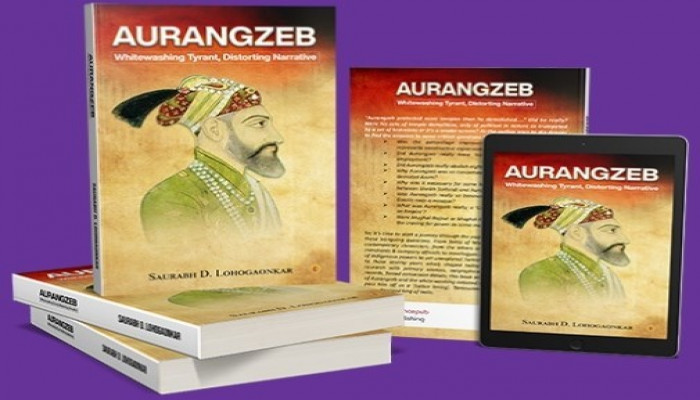
Scholar Saurabh D Lohogaonkar in his book “Aurangzeb – Whitewashing Tyrant, Distorting Narrative” published by Evincepub Publishing, demolishes all those works which whitewash the crimes perpetrated by Aurangzeb.
Primary sources are the foundation pillars for history to be accurate and truthful. Relying on primary sources and conveying the facts without distortion is one of the main responsibilities of a chronicler of history, historical events and historical characters. While relying on primary sources it is also the responsibility of the chronicler to correctly interpret the contents of the sources, examine the accounts of contemporaries and also meticulously analyse the events and happenings prior to and subsequent to the main event getting chronicled to arrive at why the central event must or must not have occurred. To accomplish this, rigorous painstaking research needs to be carried out. Saurabh Lohogaonkar has achieved this very thing and his scholarly book is proof of his monumental efforts.
The book is not a biography of Aurangzeb but is definitely a counter to the established narrative set by the “eminent historians”. The book demolishes each of the wrong claims prevailing regarding the reign of Aurangzeb, his policies and the tyrant himself. Commencing from the war of succession to the fall of Aurangzeb and his demise, from the levying of jizya to the mythical claim that Aurangzeb was a temple-protector, each and every falsehood, fake narrative, spins and twists in interpretation to suit a motivated narrative is exposed threadbare by Lohogaonkar.
The author takes up every single area where the “eminent historians” glorified Aurangzeb and whitewashed his tyranny and disprove their assertion by providing concrete evidence, sources and analysis. The impressive list of source material gives the reader an idea of how the author has gone about a mammoth task. Some examples of fake assertions by Audrey Truschke, one of the “eminent historians” and the counter by Lohogaonkar is provided herewith.
|
Issue |
"Eminent Historian" Audrey Truschke's Assertion in Aurangzeb - The Life and Legacy of India's Most Controversial King |
Author Sri Saurabh D Lohogaonkar's counter with facts |
|
Was the support of Hindu nobles to Dara and Aurangzeb equal? |
When Shah Jahan’s sons clashed in the war of succession (1657–59), Hindu members of the Mughal administration split in their support of Aurangzeb versus Dara Shukoh. More Rajputs backed Dara, whereas more Marathas (who, by the mid-seventeenth century, had become a formidable constituency) sided with Aurangzeb. But taken as a whole, twenty-one high-ranking Hindu nobles (i.e., those with an imperial Mansab rank exceeding one thousand) fought with Aurangzeb compared to twenty-four who championed Dara. In other words, Aurangzeb and Dara Shukoh garnered nearly equal support among Hindu
|
During the war of succession from 1657-59, the data shows that the number of Hindu nobles supporting Dara Shikoh was 24 out of 87 i.e., 27.6% whereas the number of Hindu nobles supporting Aurangzeb was 21 out of 124 i.e., only 16.9%, a perspective camouflaged while looking at only absolute numbers. |
|
Was Shaista Khan the Great Architect as claimed? |
Shaista Khan built lovely buildings and gardens in Pune and brought prosperity to the entire region. |
The fief of Pune was with Maharaja Shahaji Raje (father of Chhatrapati Shivaji), and when he was posted at Bangalore by Adil Shah he sent his wife - Maharani Jijabai, and his younger son Shivaji Raje to Pune to administer it. For their stay, the Lal Mahal palace and garden were built in the late 1630s, which were later occupied by Shaista Khan for his residence in 1660.
|
|
Secular fairy tale. To show the supposedly Secular nature of Aurangzeb, a couple of individual stories like Raja Raghunath or Mirza Raja Jai Singh are deliberately highlighted.
|
Aurangzeb appointed Raghunatha his Diwani, the chief finance minister of the empire. This high position mirrored Akbar’s appointment of Todar Mal as his top finance minister one hundred years earlier. At his second coronation ceremony, Aurangzeb honored his Hindu Diwani with the title of Raja and raised his Mansab rank to twenty-five hundred. Thereafter, Raghunatha ran the imperial treasury with an expert hand.
|
Raja Raghunath was brought up, patronized and introduced in the Mughal court of Shah Jahan by Sadullah Khan (a Hindu convert himself). Hence even in 1701, when Aurangzeb was thinking of him, he was mentioned as 'Raghunath Sadullah Khan', which was a major reason for his promotion in the Mughal court. |
|
Religious persecution and conversion. Persecution and the brutal execution of Guru Tegh Bahadur getting whitewashed |
The Mughal state executed Tegh Bahadur in 1675 for causing unrest in Punjab. This much is clear from both Persian and Sikh sources: In Aurangzeb’s eyes, Tegh Bahadur militarily opposed Mughal state interests and so was a legitimate target for a death sentence. His religious stature did nothing to mitigate the overarching commitment of Aurangzeb’s administration to meting out punishment, including capital punishment, to enemies of the state. It probably did not help matters that Tegh Bahadur’s nephew and the seventh Sikh guru, Har Rai, was rumored to have supported Dara Shukoh during the war of succession. Around the same time, the Mughals targeted other religious groups that took up arms against the state, such as the Satnamis.
|
After five days of brutal torture, on 10th November 1675, Guru and his companions were all taken out to the Kotwali cabutara where Bhai Mati Das was first asked to convert. On his refusal, he was sewn into two pieces while he was still alive. Next was Bhai Dayal Das, who was thrown into a cauldron of boiling oil and roasted oil. The third disciple, Bhai Sati Das, was wrapped in a cotton bundle and burnt alive; all the while Guru was kept in a cage to watch these brutalities. He was ultimately beheaded on the next day 11th November 1675, after refusing to convert (the site is today known as Gurudwara Sis Ganj in Delhi).
|
|
The Demolition of Keshav Dev Temple at Mathura |
In 1670 Aurangzeb directed the obliteration of the Keshava Deva Temple in Mathura, built in 1618 by Bir Singh Bundela, for similarly layered political reasons. Mathura Brahmins may have assisted with Shivaji’s 1666 flight from Agra. Moreover, the Keshava Deva Temple had been patronized by Dara Shukoh, Aurangzeb’s major rival for the throne. More immediately, Jat uprisings in the region in 1669 and 1670 dealt the Mughals heavy casualties. |
The first question should be, was Dara patroniser of only temples? As a practicing Muslim, he and his associates were regular patrons of the mosques or other Islamic seminaries. So why Aurangzeb selected only the temples for demolition and not those mosques or any other places frequented by Dara and his associates? Also, Dara had long been dead (executed by Aurangzeb in 1659), and many of his followers were also executed, then why suddenly it became so important for Aurangzeb to use this pretext for the demolition of Keshav Rai Temple in 1670 or for various authors to justify the same?
|
From the above examples, the reader can gauge the extent to which facts can be twisted, sources can be misinterpreted deliberately and a narrative can be scripted to suit the objective and ideology of a certain vested interest.
Lohogaonkar’s book stresses the importance of primary sources and their interpretation. It also brings out the reason for whitewashing the tyranny of most of the Islamic invaders turned rulers, especially of tyrants like Aurangzeb, thereby denying true history. This is exactly what Sri Koenrad Elst termed as “Negationism”. Whitewashing the misdeeds of Islamic invaders and rulers against the Hindus, denying their motives, ignoring the facts and blaming fringe phenomena are the classic methods and ways of Negationism employed by the “eminent historians”. The author through his counters highlights the aforementioned techniques.
Was Aurangzeb a protector of temples? Did not the reign of Aurangzeb witness the forceful conversion of Hindus to Islam? Did Aurangzeb conquer Deccan and defeat the Marathas? The myth and the efforts of the “eminent historians” try to prove everything in favour of Aurangzeb but the facts do not. The author has provided exhaustive facts coupled with detailed annexures in support of his case. Though subject-heavy, this book is a must-read for anyone interested to ascertain the truth. After reading the book, the reader can conclude that the history as chronicled by the “eminent historians” is as truthful as the Sun rising in the West!
Every Hindu knows how cruel and what an iconoclast Aurangzeb was. Yet the Hindu voices have been subdued owing to the treachery of the “eminent historians” and Hindu ‘Intellectual Kshatriyas’ getting summarily cancelled as communal by the secular brigade. Sri Jadunath Sarkar, Sri Sita Ram Goel, Sri Ram Swarup, etc were those ‘Intellectual Kshatriyas’ who were summarily cancelled for speaking the truth. Personalities can be cancelled but truth cannot be, for Truth has an uncanny habit of emerging even from the ashes and right into our faces. Lohogaonkar emerges as one of the true ‘Intellectual Kshatriya’ through this phenomenal work.
“History will always be written by hunters unless the lions learn to write. But who stopped the lions from writing it? A few among them who sold their souls to the hunters” - Quote from the trailer of Prachyam’s Indic movie “Sahebs Who Never Left”.
Lohogaonkar shows us the mirror as to who are/were those who sold themselves to the hunters.
Image Credit: https://saurabhbooks.com/
Disclaimer: The opinions expressed within this article are the personal opinions of the author. MyIndMakers is not responsible for the accuracy, completeness, suitability, or validity of any information on this article. All information is provided on an as-is basis. The information, facts or opinions appearing in the article do not reflect the views of MyindMakers and it does not assume any responsibility or liability for the same.


 Loading...please wait
Comments